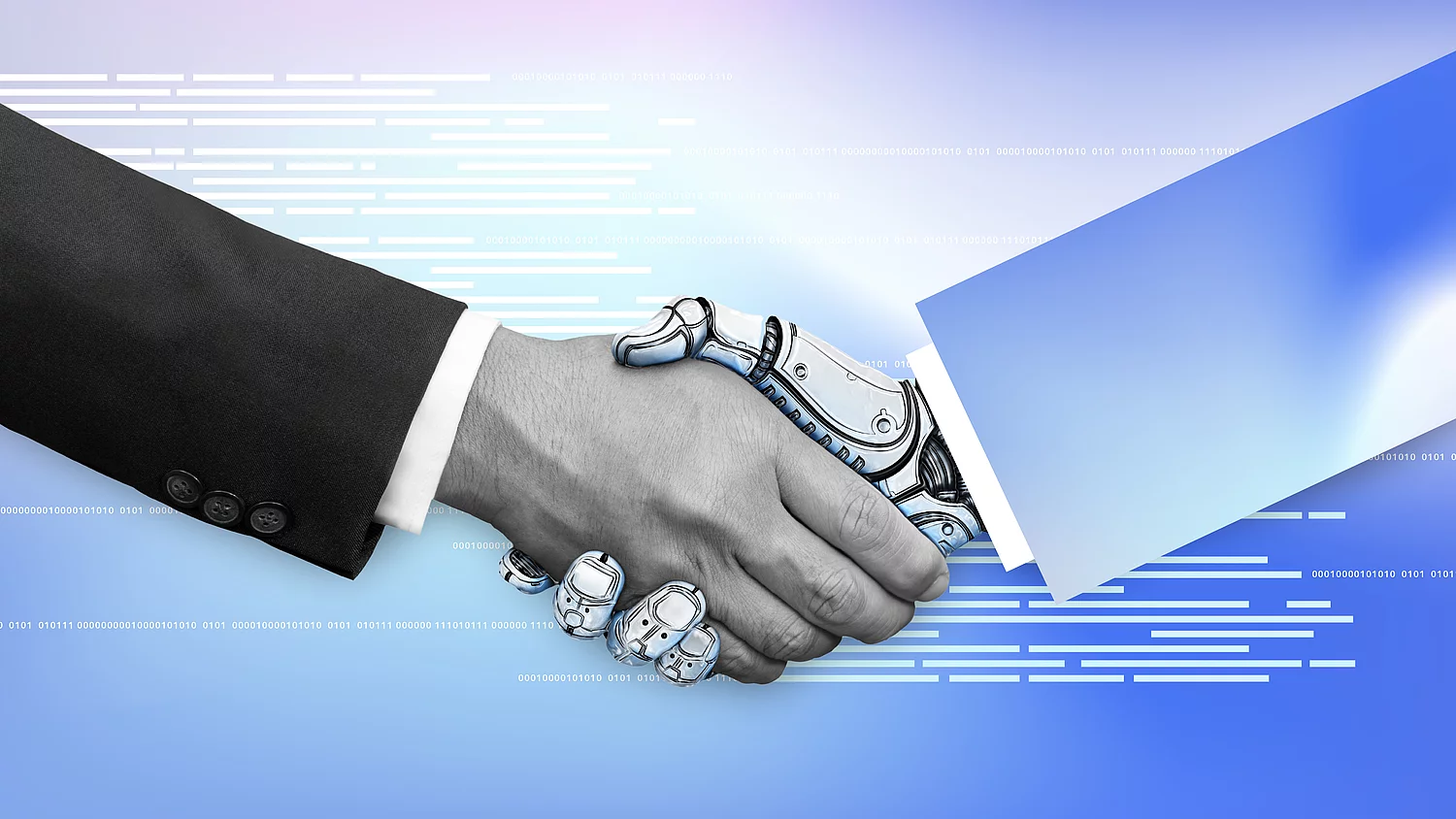
Searching, clicking, navigating from subpage to subpage: Even in the age of AI, the internet still seems stuck in its old ways. We manually enter prompts into chat windows, copy and paste text back and forth, and in the end, we end up doing the actual work ourselves. This is exactly where today’s technology often becomes nothing more than a nice gimmick. But what happens if we turn the tables? What if the website of the future no longer merely reacts to our inputs, but thinks for itself, plans, and solves complex tasks independently for us?
Welcome to the age of the Agentic Web.
The leap from abstract theory to practice
To bring this very next stage of digital evolution to life, we set theory aside and turned our ideas into concrete prototypes during our internal UX hackathon. Our goal was to look ahead: As a complement to our day-to-day project work, we wanted to use traditional websites and interfaces as a testing ground in the age of Agentic AI and fundamentally reexamine them. Free from fixed constraints or budgets, we put our ideas to the test.
This once again highlighted the agility and strong team spirit driving us at SNK to build groundbreaking solutions:
Our UX team, working together with our AI and front-end experts, has developed interfaces that are immediately intuitive.
The result: Four compelling concepts that impressively demonstrate the potential of Agentic AI.
4 Visions for the Internet of Tomorrow
1. The Hand (B2B Personal Assistant)
A central AI master agent orchestrates the workflow in the background, directing specialized expert personas to significantly reduce the user’s workload. For example, if an event manager’s caterer cancels at the last minute, "The Hand" reacts immediately: The system analyzes alternatives, calculates risks, and delivers a ready-to-execute decision template to the dashboard. The user retains full control, while the AI eliminates the organizational stress.
2. Day Planner 2.0 (B2C)
A smart everyday companion that provides users with perfect support based on a comprehensive digital profile (drawn from calendars, preferences, and fitness data). For example, the system plans out an entire free Saturday—from breakfast to a visit to an exhibition. To intentionally contrast with real photos, the AI brings the experience to life through live-generated, emotionally engaging cartoon illustrations.
3. Moments of Delight (AI with Personality)
Digital interfaces don’t have to be sterile. This concept brings the human element and genuine emotions back to the web. Instead of anonymous, generic bots, an AI with a unique, distinctive brand personality takes the lead. As a digital brand ambassador, it creates targeted “wow moments” (moments of delight) on the website, greets users individually, and builds genuine trust.
4. Website of the Future (B2B Control Center)
Say goodbye to confusing B2B navigation and endless marketing pages. This concept replaces rigid site structures with a dynamic mixed-agent interface that serves as a central control center. Through hyper-personalization, the website immediately recognizes the user’s role—such as a technician for specific systems. Interfaces, tools, and action buttons adapt in real time to the user's context to solve complex tasks in the blink of an eye.
UX, Data, and Safety: The Key Drivers for Agentic Web
The results of the hackathon make clear that the implementation of agent-based concepts is not a theoretical vision of the future, but is already technically feasible today. The key factor for success usually does not lie in the underlying AI models themselves. Rather, what matters most is a well-thought-out UX design, a cleanly structured, context-based use of data, and a reliable safety framework (safety scaffolding) that sets clear boundaries for the agents.
This Is How We Put the Future into Practice
The insights and prototypes from our hackathon are now being directly incorporated into our daily work. We’re using the frameworks we developed to reevaluate existing approaches and create future-proof, agent-based web concepts for our clients.
And that’s not all: We’re already planning the next hackathon!
In the meantime, we have an exciting deep dive on the topic of the Agentic Web for you. Interested? → Agentic Web – The Future of the Website.