
In this article:
- Why SEO Must Be Part of a Relaunch
- Where Traffic Is Typically Lost
- Phase 1: Analysis of the Current State of the Existing Website
- Phase 2: Keyword Research and Content Mapping
- Phase 3: Redirects and URL Structure
- Phase 4: Technical SEO
- Phase 5: Go-Live
- Phase 6: Post-Launch Monitoring
- Real-World Example
- Why SNK?
Why SEO Must Be Part of a Relaunch
When the URL structure, templates, or CMS change, Google and AI agents must reindex the page. With clean 301 redirects and a stable domain, the majority of ranking signals are preserved—Google has publicly confirmed this on multiple occasions. However, if redirects are missing, canonical tags are set incorrectly, or the sitemap doesn’t match the actual URL structure, search engines lose their frame of reference. The result: pages drop out of the index, rankings plummet, and leads dry up.
SEO during a relaunch is therefore not a task to be tacked on at the very end. Ideally, it’s integrated from day one—from requirements analysis and CMS selection all the way through post-launch monitoring.
Where Traffic Is Typically Lost
The most common causes of drops in visibility after a relaunch aren’t anything spectacular. They’re technical errors that are easy to predict and avoid:
- Old URLs are not redirected at all or are redirected en masse to the homepage
- The “staging-noindex” tag remains active after the site goes live
- The XML sitemap lists URLs that no longer exist—or omits new pages
- Versions with and without a trailing slash are accessible simultaneously
- Canonical tags are missing or point to incorrect targets
- robots.txt blocks resources needed for rendering
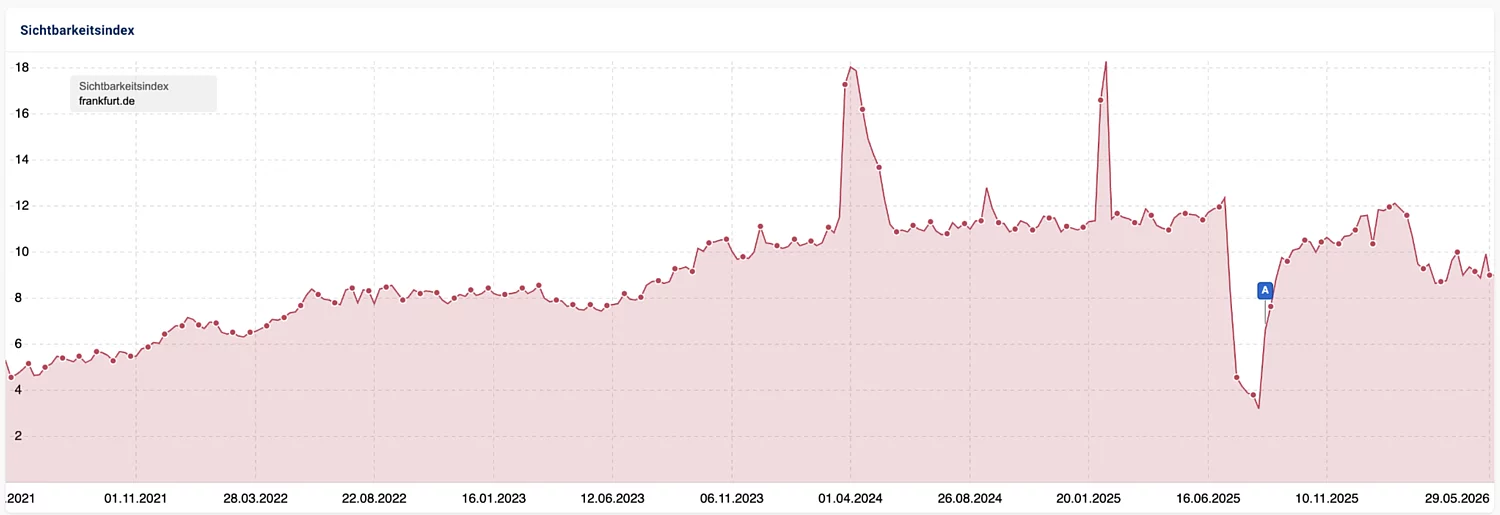
The SEO visibility of frankfurt.de plummeted in July 2025 due to a failed relaunch (Source: Sistrix)
Phase 1: Analysis of the Current State of the Existing Website
Before any work begins on the new system, a complete audit of the old site is required. This includes three data sets:
A crawl of the existing domain. First, every URL should be captured via a crawl—including status code, title, description, H1, canonical tag, internal links, and indexability. The result is a table that will later serve as the basis for redirect mapping.
Performance data from the last 12 months. From Google Search Console: Which URLs generate clicks and impressions, and for which search queries do these URLs rank? From Analytics or Matomo: sessions, conversions, and assisted conversions. This reveals which pages have real business value.
Backlink profile. The most important linked URLs can be identified using Search Console and supplementary SEO tools. These are precisely the URLs that must not be lost during the relaunch.
Combining these three data sets yields a prioritized list: Which pages must be carried over 1:1, which ones will be merged, and which ones can be omitted if necessary.
Phase 2: Keyword Research and Content Mapping
A relaunch is the right time to review your keyword set. B2B search behavior changes, new competitors enter the market, and your own products are repositioned. A one-to-one mapping is crucial here: Each prioritized keyword is assigned exactly one target URL. This prevents multiple pages on your site from competing for the same keyword.
Based on the research, three decisions are made for each existing page:
- Keep and carry over: The page ranks well, has traffic, and the content is up to date.
- Consolidate: Merge multiple thin pages into a comprehensive hub.
- Remove: The page has no clicks, no backlinks, and no strategic relevance—use a clean 410 status code instead of zombie content.
Phase 3: Redirects and URL Structure
Redirect mapping is where most relaunches fail. The logic is simple, but the implementation requires meticulous attention to detail.
Basic rules:
- Permanent redirects should be set up as 301s, not 302s.
- Every old URL is assigned a thematically appropriate new equivalent. Blanket redirects to the homepage generate soft 404s and are considered “unhelpful” by Google.
- If there is no equivalent and the page was historically unimportant, a 410 is a more honest response than a 404.
- Avoid redirect chains: A → B → C should be resolved to A → C. Each additional step consumes crawl budget and delays resolution.
- For several thousand URLs, a mix of rule-based redirects (such as path patterns via RegEx) and manual individual mapping for top URLs is recommended.
- For international relaunches: Hreflang relationships must be maintained on a 1:1 basis; otherwise, ambiguous language signals will result.
Before going live, the redirect list is checked against crawl data in a staging environment: Does each entry point to the correct destination URL, with a 301 status code, and without any detours?
Phase 4: Technical SEO
The technical foundation determines how efficiently Google crawls and indexes the new site. Four key areas should be addressed before the site goes live:
Core Web Vitals. Realistic target values: LCP under 2.5 seconds, INP under 200 milliseconds, CLS under 0.1. A classic relaunch pitfall: The new brand font is loaded via an external provider and throws off the LCP. Solutions include font preloading, self-hosting, or `font-display: swap`.
Indexing control. Robots.txt, LLM.txt, and meta-robots directives must be configured precisely. In the CMS, the canonical tag, noindex flag, and sitemap inclusion should be controllable on a per-page basis—if you can only set these globally, you have no control over the details.
Structured data. For B2B product pages, Schema.org markups (Product, Organization, BreadcrumbList, FAQPage) are worthwhile. They don’t directly improve rankings, but they do enhance the display in the SERPs and thus the click-through rate.
Mobile and Rendering. Google indexes using a mobile-first approach. If the page reloads key content via JavaScript, you should use the URL Inspection Tool in GSC to verify whether Google actually sees this content.
A note on bounce rate: Since the introduction of GA4, it is no longer a standard metric and is not a direct ranking factor. To measure user behavior, look at engagement rate, scroll depth, and conversion paths.
Phase 5: Go-Live
The go-live should be scheduled for a time when traffic is low; in B2B, this is typically Friday evening or Saturday (but be sure to check afterward to make sure everything went smoothly before heading into the weekend). Before and after the go-live, these items must be included on the checklist:
Before going live:
- Staging environment protected by Basic Auth, not just via `noindex`
- Compare the staging sitemap against the crawl list: no missing or duplicate URLs
- All redirects tested in staging
At go-live:
- Remove the `noindex` header or `robots: disallow` directive from the live site—this is by far the most common single mistake
- Submit the new XML sitemap to Search Console
- When changing domains: Use the Change of Address tool in Search Console
- Start a full crawl of the live site and check it against the redirect matrix
In the first 24 hours:
- Run a GSC URL Inspection for the top 20 URLs: Is the page rendering correctly? Is it indexable?
- Check live server logs: How is Googlebot responding? Which 404 errors are appearing?
Phase 6: Post-Launch Monitoring
The first two to four weeks determine how quickly Google processes the new structure. A slight dip in visibility during this phase is normal; a sustained decline is not.
What to monitor:
- GSC Indexing Report: Is the number of “Found – currently not indexed” URLs increasing? Are unexpected 404 errors appearing? Is the sitemap being processed without errors?
- Sistrix or similar tools: How is the visibility index trending at the domain and directory levels? Which top rankings have disappeared, and which new ones are emerging?
- Server logs: Which URLs is Google crawling, and how often? Does the bot get lost in parameter URLs or filter pages?
- Conversion tracking: Are lead forms working technically, and is the tracking running smoothly?
If no recovery is visible after two weeks, a systematic troubleshooting process is warranted. Experience shows that the cause usually lies in one of the following areas: redirect gaps, sitemap inconsistencies, incorrect canonicals, or accidental “noindex” directives.
Case Study: What Went Wrong at a B2B Manufacturer
One of our current clients launched a new website without direct SEO support during the project. The problems became apparent within a few weeks: organic visibility plummeted, product pages disappeared from the index, and inquiries through the website dropped measurably.
A Screaming Frog crawl comparing the GSC indexing report and the submitted sitemap revealed the following issues, among others:
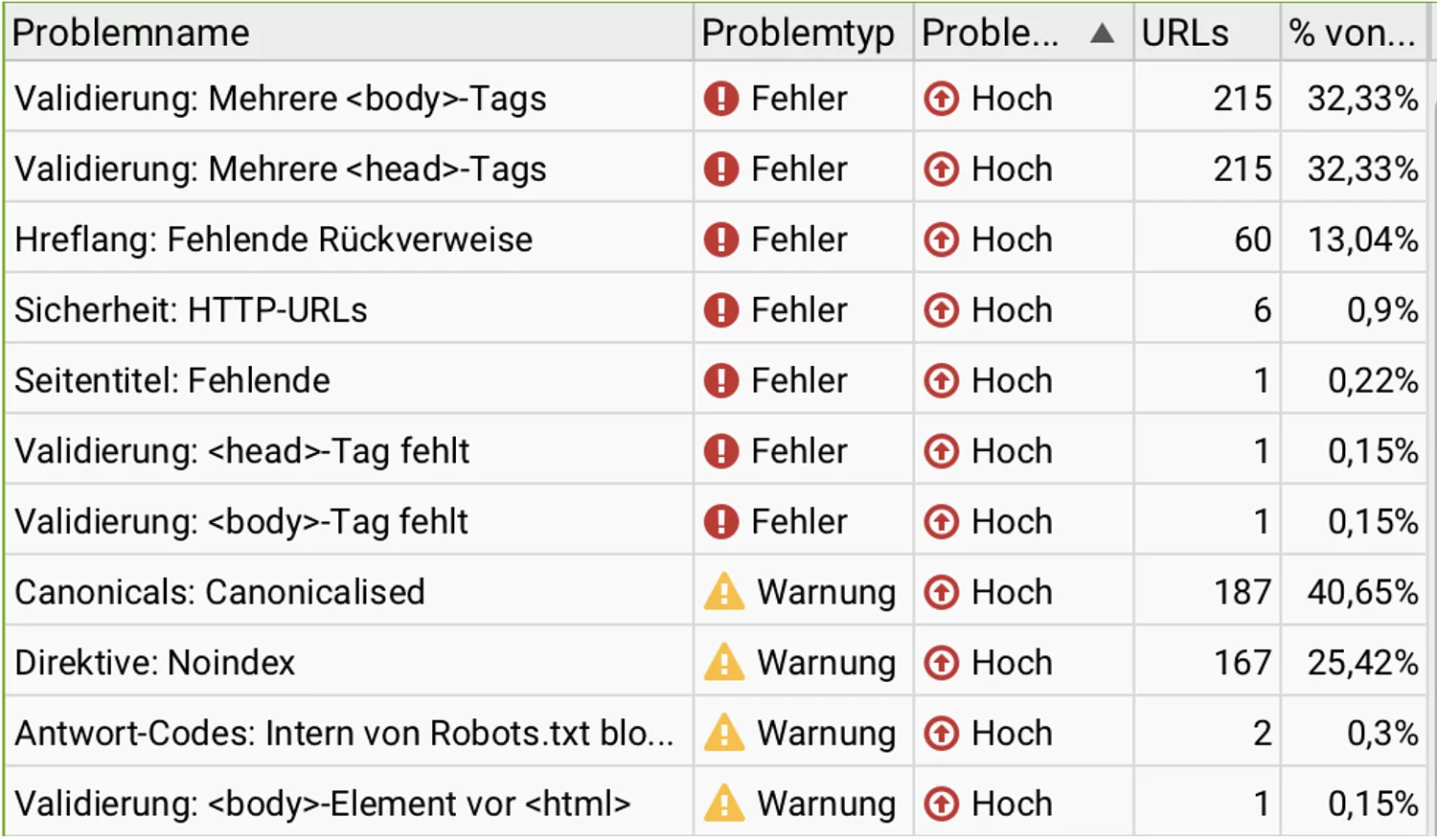
Trailing-slash routing. Product pages were accessible both with and without a trailing slash. Both versions returned a 200 status code, and both were indexed. Without a canonical tag, Google treated this as duplicate content and decided on its own which version to include in the index—often the weaker one.
Duplicate URL structures. The same products were also accessible via category paths and via a flat product URL.
Sitemap not synchronized with the actual product pages. The XML sitemap listed URLs that had been removed during the relaunch and omitted some of the new product pages. This sent conflicting signals to Google.
Poorly structured HTML. Many of the pages had multiple `<head>` and `<body>` tags, as well as multiple H1 headings.
Outdated CMS. The system in use did not offer clean control over canonical tags, consistent URL normalization, or reliable sitemap generation. The problems could not be solved through better editorial practices but were structurally rooted.
The following steps were necessary to resolve the issues: enforced URL normalization via web server configuration (redirecting the slash variant to the canonical form), cleaning up duplicate paths using 301 redirects and canonical tags, manually regenerating the sitemap while cross-checking it against the live crawl, and ensuring a clean HTML structure. In the medium term, a CMS change was on the horizon anyway, because a system without control over canonicals, hreflang, and indexing is not viable for an international B2B business.
The lesson learned from this project isn’t new, but it’s exemplified here: indexing problems rarely stem from a single error. They arise when several small technical issues accumulate and the CMS lacks the tools to systematically resolve them.
FAQs
How long does an SEO relaunch take?
SEO work spans the entire project duration. It begins with an analysis of the current state prior to the concept phase and ends, at the earliest, four weeks after go-live with ongoing monitoring. It does not function as an isolated work package block at the end of the project—the decisions affecting SEO are established too early in the process (information architecture, URL structure, CMS selection).
Do you always lose traffic after a relaunch?
In the short term, fluctuations are normal because Google is re-evaluating the new structure. If the relaunch is carried out properly, visibility should recover within four to eight weeks and, in the medium term, exceed the initial level—provided that the new site is technically superior and, in terms of content, at least equivalent to the old one.
Can the SEO aspect be handled in-house?
Yes, if the necessary expertise is in-house. The question is really how much risk a company is willing to take. A 40 percent drop in visibility over half a year often means significant lead losses in the B2B sector. External support costs only a fraction of that.
Why SNK?
We provide comprehensive support for relaunches in the B2B sector—from concept development and technical implementation to SEO monitoring after the go-live. This means that the topics covered in this article aren’t spread across different departments but are coordinated by a single team. If you’re planning a relaunch and want to accurately assess the risk to your organic visibility, sign up for an initial audit consultation.
Conclusion
A well-executed SEO relaunch isn’t a safeguard against losses—it’s an opportunity. The inventory data shows exactly which pages have business value, the mapping forces a clean URL structure, and the technical setup is freed from the baggage of old systems. Those who take ownership of SEO from the very beginning—not just two weeks before go-live—not only navigate the relaunch without losses but often end up in a significantly better position than before.